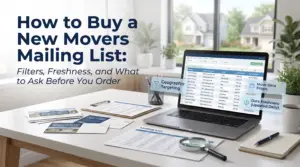
Household marketing services supply the names and postal addresses of households so a business can mail them directly. The most useful files are built on dated records, such as a recorded property sale, rather than guesses about who lives where. Which one you need depends on whether you are buying timing or coverage.
Every household has someone who decides: who the plumber is, which insurance to renew, whether the lawn gets a service or a teenager with a mower.
Reaching that person is the whole job, and most of the difficulty is timing rather than persuasion. The question is whether you arrive while the decision is still open.
Homeowners Marketing Services was founded in 1967 and has operated in its current form for more than 50 years. In our experience, the companies that do well with mail are often not the ones with the best letter. They are the ones that showed up first.
What Household Marketing Services Supply
A file: names, postal addresses, and whatever selection criteria you applied when you ordered. The category attracts vague language, so it is worth saying that is all it is. We cover the formats and what a file does and does not contain in what a consumer mailing list actually contains. What differs from file to file is what it was built from and how recent it is.
A Doorway, Not a Person
Digital advertising sells you a person, or something that claims to be one. Household marketing sells you a doorway.
That sounds like less, and in practice it is often more. A letter addressed to a house reaches whoever opens the mail, who is frequently the same person deciding which trades get called. You do not have to identify the decision-maker. You have to put something physical where the decision happens.
It also simplifies the targeting problem. You do not need to know who lives at an address, only that something changed there recently.
Three Moments Worth Mailing
Somebody bought the house. This is the strongest moment. A new owner has no local plumber, roofer, or insurance agent and no loyalty to anyone, and every one of those relationships is about to be settled. By our reading, buying habits form in the first 30 days after a move, and most new purchases happen within the first 90.
Somebody moved in. A move resets habits even without a purchase: a different commute, different shops, different routines.
Nothing happened, but the street needs to know you exist. A restaurant opening on a corner, or a dental practice that wants every household within two miles to have heard of it. This is coverage rather than timing, and it is a legitimate reason to mail.
The first two are worth testing before you pay for coverage you may not need.
Matching the List to the Moment
New homeowners. Our core file, and what marketing to homeowners usually means. We build it from county recorders’ offices, where property transfers are filed, and deliver it weekly as standard. Monthly and daily delivery are also available, with an extra fee for daily. In most metro areas, we put names in your hands about three weeks ahead of competing list companies. The file does not include renters.
New movers. A new movers mailing list is organized around the move rather than the purchase, which makes it the right choice when the relocation is the trigger you care about. We compile it weekly, and we cover how to judge one before you order in a separate guide.
Consumer lists. Consumer lists are built on who somebody is: age, gender, location. They are refreshed daily and suit broad local awareness. They are the wrong tool if you are waiting for a moment.
A demographic list tells you a household exists. A recorded deed tells you something has just changed there. They are different products, and they are not interchangeable.
A Worked Example
Take a roofing contractor who can reasonably reach about fifteen miles from the shop. A consumer file for that whole circle gets the name to every household, including the many that have no roof to sell. A new homeowner file for the same circle reaches only people who have just bought and have no local roofer yet. It is a much smaller file and a much better-timed one. Add a purchase-price band so the offer fits the homes on the list, and the mailing gets smaller and sharper again.
Neither choice is wrong. If the same contractor were announcing a new location, the wider file would be the better call.
The Filters That Matter
Geography does most of the work: a radius around your location, ZIP codes, or counties. Most businesses set it too wide, and our free radius lookup tool can help you test a tighter one. On the homeowner file, you can also select by purchase price and loan amount, and separate single-family homes from multi-dwelling units. Refinancers are available separately, which is a different conversation and often a better one. Around 10 to 15 percent of new homeowner records include a phone number: not enough to build a calling program on, but enough to follow up with the people who respond.
What It Costs
Names run between 9 and 25 cents each depending on average monthly volume, and higher volumes bring the per-name price down. Most clients take a weekly subscription billed monthly rather than a one-off order, because new records keep arriving. Refinancers are priced separately, at 9 cents a name plus a processing fee of up to $75, which is waived on orders above 10,000 names.
Postage and printing will usually cost as much as the data or more, so the number worth pressing on is deliverability. We guarantee at least 93% of the names we supply are deliverable.
Before You Choose a Provider
Ask where the data came from, how recently it was compiled, and who you will call when you want to change something a month in. We have set out the five questions worth asking before you order in our guide to buying a movers list, and they apply to us as much as to anybody else.
See Real Records First
We will send a free sample for your ZIP codes so you can look at real records before spending anything. Tell us the areas you want at 888-888-5557, and we will get back to you by the next business day.
FAQs
What are household marketing services?
Companies that supply household names and postal addresses for direct mail, usually with selection criteria so you can narrow to a territory or a price band. The better ones build their data from recorded events such as property transfers rather than inferring who lives where.
Is homeowner marketing better than a general consumer list?
For most local service businesses, usually yes, because a homeowner file is built on something that happened rather than on a demographic profile. A consumer list earns its place when you want broad coverage of an area rather than a specific moment.
Which households should I mail first?
The ones closest to you. Coverage you can service beats coverage you cannot, and a tight territory mailed repeatedly will out-earn a wide one mailed occasionally.
Do you send the mail as well?
Yes. Our print-and-mail service handles addressing, folding, inserting, sealing, and mailing, with tracking and reporting. Timing depends on volume, so ask for a timeline with your quote. You can also take the file and handle it yourself.