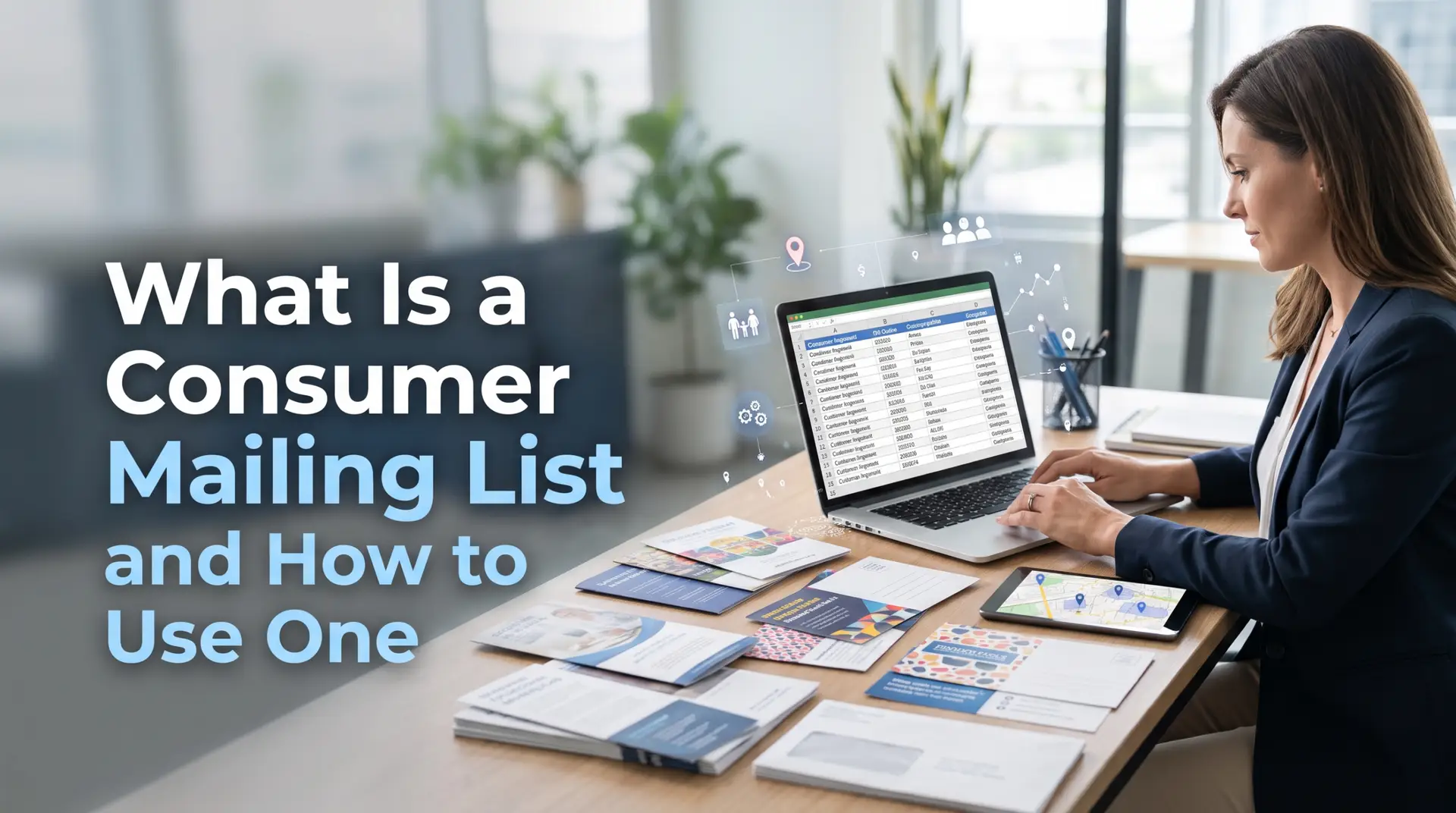
A consumer mailing list is a file of household names and postal addresses, selected by criteria like age, gender, and location, that a business uses to send direct mail. The names come from legal public-domain sources. It suits broad local awareness campaigns, and it is the wrong tool when you need people who have just done something specific.
We get asked what a consumer mailing list is more often than you would think, usually by somebody who has already been sold one by someone else and is not sure what they bought.
So here is the plain version, including the part most list companies leave out: when you should not buy one.
What You Are Actually Buying
A consumer mailing list is a file of households: names, postal addresses, and whatever selection criteria you applied when you ordered it.
That is all. It is not a database you log into; it is not a subscription to software, and it is not a set of people who have asked to hear from you. It is a list of addresses, delivered as a file, that you then mail something to.
You will get it as a CSV or Excel file, or as mailing labels if you would rather not deal with a mail merge. We do not supply email addresses on any of our lists. If you want email, you will need to match the file against a third-party provider that does.
Where the Names Come From
Our consumer file is built from legal public-domain sources and refreshed daily. Our homeowner data, which is a different file, comes mainly from one place in particular: county recorders’ offices, where property transfers get filed.
That distinction explains what each file is good at. A property record tells you a transaction happened on a date at an address. It is factual, it is dated, and it is checkable. A consumer file tells you who lives where and a few things about them, such as age bracket and household composition.
Different providers sit on different sources, and any list provider worth using will tell you where theirs came from. If you ask and the answer is vague, that is your answer.
When a Consumer List Is the Wrong Tool
Here is the part that costs us orders occasionally.
A general consumer list is built on who somebody is: their age bracket, their location, the household composition. It is not built on what they just did. For a lot of businesses, what somebody just did is the only thing that matters.
If you sell to people at a moment, such as insurance at closing, HVAC after a purchase, or lawn care for a new owner, you want a trigger list, not a demographic one. Our new homeowners file exists because a recorded deed is a trigger and an age bracket is not. If you are still deciding which moment fits your business, we have set out the three moments worth mailing in a separate guide.
Where a consumer list genuinely earns its place is broad local awareness. A restaurant opening on a corner. A dental practice that wants every household within two miles to know it exists. A retailer running a seasonal promotion across a few ZIP codes. In those cases, you are not waiting for a moment; you are buying coverage, and a consumer list is exactly right.
The Filters That Do Most of the Work
You can slice a list a hundred ways, and most of it is noise. Three selections carry nearly all the value:
Geography. By far the most important, and the one most businesses underuse. Tight beats broad almost every time. Two thousand households you can actually serve beat twenty thousand you cannot.
Age. Useful when your product has a genuine age skew, and a waste of a filter when it does not.
Gender. The same test applies, and it is stricter than people expect. If you cannot explain why half the households in your area should not receive your mail, leave it alone.
Our consumer mailing list data is refreshed daily, and you can take free samples by ZIP code or by your selection criteria before ordering anything.
What It Costs, and What to Check Before You Buy
Names run between 9 and 25 cents depending on how many you take each month, with higher volumes bringing the per-name price down.
The number worth asking about is not price, though. It is deliverable. Every undeliverable address on a file is postage spent on nothing, and on a ten-thousand-piece drop a few percentage points is real money. We guarantee at least 93% of the names we supply are deliverable, which is a number we publish rather than imply.
Two other things to check with any supplier. Ask where the data came from. And ask who you will deal with when you have a question a month in: with us it is a small team that gets to know your account, rather than a different person each time.
The mail itself still gets looked at, which is the part people doubt. If you want data on that rather than opinion, the USPS Household Mail Survey tracks how households actually handle what arrives, year after year, and it is published openly.
We will send a free sample so you can look at real records for your area before you spend anything. Call 888-888-5557 and tell us the ZIP codes.
FAQs
What is the difference between a consumer mailing list and a business mailing list?
A consumer list reaches households at their home addresses. A business list reaches companies at their business addresses, and the selection criteria are things like industry and company size rather than age and household composition. Which one you want depends entirely on who signs the check for what you sell.
Should I buy a consumer list or a new homeowners list?
If your business depends on reaching people at a particular moment, such as a move or a purchase, the new homeowners file is the one you want, because it is built on a dated event rather than a demographic. If you are buying coverage of an area and the timing matters less, a consumer list reaches more households for the money. Plenty of businesses run both.
How many names do I need for a direct mail campaign to work?
Fewer than most people assume, and mailed more often. A thousand households mailed monthly will teach you more and usually return more than ten thousand mailed once. Start with a territory you can service and build out from there.
Can I just buy a list once and keep using it?
You can, but it decays quickly. People move, and a file that was accurate in March will not be in September. That is why most of our clients take a weekly subscription rather than a one-off order: the names refresh underneath them, and they are always mailing current addresses.